Pearson Corr. Coef.
Module Interface
- class torchmetrics.PearsonCorrCoef(num_outputs=1, **kwargs)[source]
Computes Pearson Correlation Coefficient:
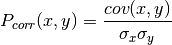
Where
 is a tensor of target values, and
  is a tensor of predictions.
As input to
forwardandupdatethe metric accepts the following input:preds(Tensor): either single output float tensor with shape(N,)or multioutput float tensor of shape(N,d)target(Tensor): either single output tensor with shape(N,)or multioutput tensor of shape(N,d)
As output of
forwardandcomputethe metric returns the following output:pearson(Tensor): A tensor with the Pearson Correlation Coefficient
- Parameters
num_outputs¶ (
int) – Number of outputs in multioutput settingkwargs¶ (
Any) – Additional keyword arguments, see Advanced metric settings for more info.
- Example (single output regression):
>>> from torchmetrics import PearsonCorrCoef
>>> target = torch.tensor([3, -0.5, 2, 7])
>>> preds = torch.tensor([2.5, 0.0, 2, 8])
>>> pearson = PearsonCorrCoef()
>>> pearson(preds, target)
tensor(0.9849)
- Example (multi output regression):
>>> from torchmetrics import PearsonCorrCoef
>>> target = torch.tensor([[3, -0.5], [2, 7]])
>>> preds = torch.tensor([[2.5, 0.0], [2, 8]])
>>> pearson = PearsonCorrCoef(num_outputs=2)
>>> pearson(preds, target)
tensor([1., 1.])
Initializes internal Module state, shared by both nn.Module and ScriptModule.
Functional Interface
- torchmetrics.functional.pearson_corrcoef(preds, target)[source]
Computes pearson correlation coefficient.
- Example (single output regression):
>>> from torchmetrics.functional import pearson_corrcoef
>>> target = torch.tensor([3, -0.5, 2, 7])
>>> preds = torch.tensor([2.5, 0.0, 2, 8])
>>> pearson_corrcoef(preds, target)
tensor(0.9849)
- Example (multi output regression):
>>> from torchmetrics.functional import pearson_corrcoef
>>> target = torch.tensor([[3, -0.5], [2, 7]])
>>> preds = torch.tensor([[2.5, 0.0], [2, 8]])
>>> pearson_corrcoef(preds, target)
tensor([1., 1.])
- Return type