Precision Recall
Functional Interface
- torchmetrics.functional.precision_recall(preds, target, average='micro', mdmc_average=None, ignore_index=None, num_classes=None, threshold=0.5, top_k=None, multiclass=None)[source]
Computes Precision
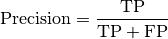
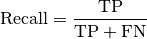
Where
 text{FN}` and
  represent the number
of true positives, false negatives and false positives respecitively. With the use of
represent the number
of true positives, false negatives and false positives respecitively. With the use of
top_kparameter, this metric can generalize to Recall@K and Precision@K.The reduction method (how the recall scores are aggregated) is controlled by the
averageparameter, and additionally by themdmc_averageparameter in the multi-dimensional multi-class case. Accepts all inputs listed in Input types.- Parameters
preds¶ (
Tensor) – Predictions from model (probabilities, logits or labels)Defines the reduction that is applied. Should be one of the following:
'micro'[default]: Calculate the metric globally, across all samples and classes.'macro': Calculate the metric for each class separately, and average the metrics across classes (with equal weights for each class).'weighted': Calculate the metric for each class separately, and average the metrics across classes, weighting each class by its support (tp + fn).'none'orNone: Calculate the metric for each class separately, and return the metric for every class.'samples': Calculate the metric for each sample, and average the metrics across samples (with equal weights for each sample).
Note
What is considered a sample in the multi-dimensional multi-class case depends on the value of
mdmc_average.Note
If
'none'and a given class doesn’t occur in thepredsortarget, the value for the class will benan.mdmc_average¶ (
Optional[str]) –Defines how averaging is done for multi-dimensional multi-class inputs (on top of the
averageparameter). Should be one of the following:None[default]: Should be left unchanged if your data is not multi-dimensional multi-class.'samplewise': In this case, the statistics are computed separately for each sample on theNaxis, and then averaged over samples. The computation for each sample is done by treating the flattened extra axes...(see Input types) as theNdimension within the sample, and computing the metric for the sample based on that.'global': In this case theNand...dimensions of the inputs (see Input types) are flattened into a newN_Xsample axis, i.e. the inputs are treated as if they were(N_X, C). From here on theaverageparameter applies as usual.
ignore_index¶ (
Optional[int]) – Integer specifying a target class to ignore. If given, this class index does not contribute to the returned score, regardless of reduction method. If an index is ignored, andaverage=Noneor'none', the score for the ignored class will be returned asnan.num_classes¶ (
Optional[int]) – Number of classes. Necessary for'macro','weighted'andNoneaverage methods.threshold¶ (
float) – Threshold for transforming probability or logit predictions to binary (0,1) predictions, in the case of binary or multi-label inputs. Default value of 0.5 corresponds to input being probabilities.Number of highest probability or logit score predictions considered to find the correct label, relevant only for (multi-dimensional) multi-class inputs. The default value (
None) will be interpreted as 1 for these inputs.Should be left at default (
None) for all other types of inputs.multiclass¶ (
Optional[bool]) – Used only in certain special cases, where you want to treat inputs as a different type than what they appear to be. See the parameter’s documentation section for a more detailed explanation and examples.
- Returns
precision and recall. Their shape depends on the
averageparameterIf
average in ['micro', 'macro', 'weighted', 'samples'], they are a single element tensorIf
average in ['none', None], they are a tensor of shape(C, ), whereCstands for the number of classes
- Return type
The function returns a tuple with two elements
- Raises
ValueError – If
averageis not one of"micro","macro","weighted","samples","none"orNoneValueError – If
mdmc_averageis not one ofNone,"samplewise","global".ValueError – If
averageis set butnum_classesis not provided.ValueError – If
num_classesis set andignore_indexis not in the range[0, num_classes).
Example
>>> from torchmetrics.functional import precision_recall
>>> preds  = torch.tensor([2, 0, 2, 1])
>>> target = torch.tensor([1, 1, 2, 0])
>>> precision_recall(preds, target, average='macro', num_classes=3)
(tensor(0.1667), tensor(0.3333))
>>> precision_recall(preds, target, average='micro')
(tensor(0.2500), tensor(0.2500))